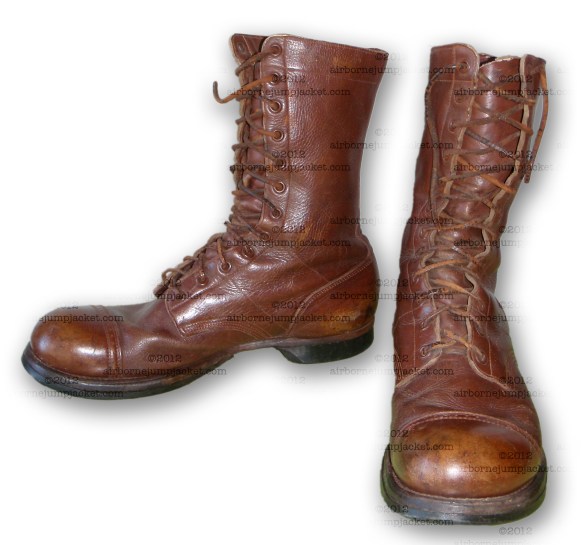
WWII US Airborne Paratrooper Jump Boots Dated 1942

Classic WW2 jump boots.

These WW2 paratrooper jump boots exhibit all of the typical features that are seen in World War Two era US jump boots.  They are brown, have the slant heel, and have the reinforcements sewn into the ankle area.  They also have the leather laces that were preferred by WW2 era paratroopers.  This is an early pair, they are dated 1942 inside.

After the US Airborne forces were first formed, it was decided that paratroopers needed a special boot to help protect their feet and ankles from the shock of a parachute landing.  The standard US infantry boot of the period was a short leather boot that did not give the required support, especially to the ankle area.  Thus, jump boots were made longer and had extra support sewn into the ankle area.  Additionally, the front of the heels were slanted to help prevent the boots from getting caught in the parachute lines as the chute deployed.

Jump boots became one of the iconic symbols of the US paratroopers during World War Two.  They were worn in combat and also worn as part of the dress uniform.

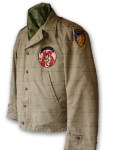
WW2 Airborne M41 Jacket with 513th PIR Pocket Patch

M41 Jacket with 513th PIR Pocket Patch

Here we have a nearly mint, World War Two M41 field jacket.  These were worn by the US Army in the ETO all through the war.  This particular jacket belonged to a paratrooper of the 513th Parachute Infantry Regiment who had a 513th PIR pocket patch sewn on to his jacket.  The 513th was at that time part of the 13 Airborne Division. It was later transferred to the 17th Airborne Division, where it became famous for its participation in the Battle of the Bulge and also Varsity, where it made a combat jump.

This particular paratrooper was later transferred to the 517th Parachute Infantry Regiment during the war.  This probably explains why this jacket is in such pristine condition and why it still has the 13th Airborne Division patch on it.  I suspect that after his transfer, he never wore this jacket again.

The 513th Parachute Infantry Regiment pocket patch is one of my favorite Airborne patches of WWII.  I just love the graphics on them.

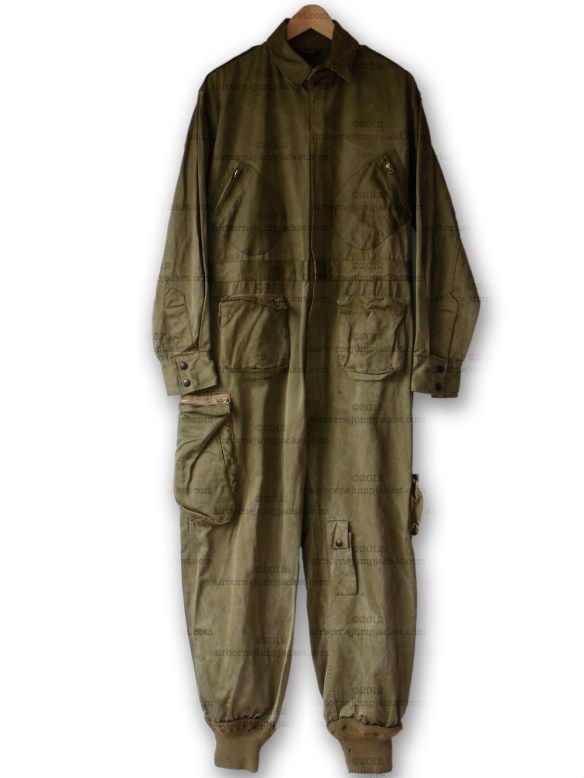
Paratrooper Balloon Suit Uniform, Rare Early WW2 Airborne Jump Training Uniform

Pictured is an early US paratrooper uniform item.  It is commonly referred to as a balloon suit, balloon jump suit or balloon cloth jump suit.  This was one of the earliest uniform items specifically designed for US paratroopers.  It was designed to be worn by paratroopers as an outer garment when making their parachute jumps.   It was only experimented with for a brief time.  Most photos show it being used in training in 1941.  By 1942, it had been supplanted by other uniforms like the M42 jump suit.  Although it was only used briefly, photos taken at the time show that many of the paratroopers who would later go on to have prominent positions in the 101st Airborne Division, 82nd Airborne Division, 11th Airborne Division, 17th Airborne Division, and 13th Airborne Division during World War Two, got their jump training wearing this uniform.

Since it was only used for a short period of time, and also because during this time the size of the US Airborne forces were very small, very few have survived.   They are considered very rare and only a handful still exist in collections today.  I was very pleased to add this rare uniform to my military collection.

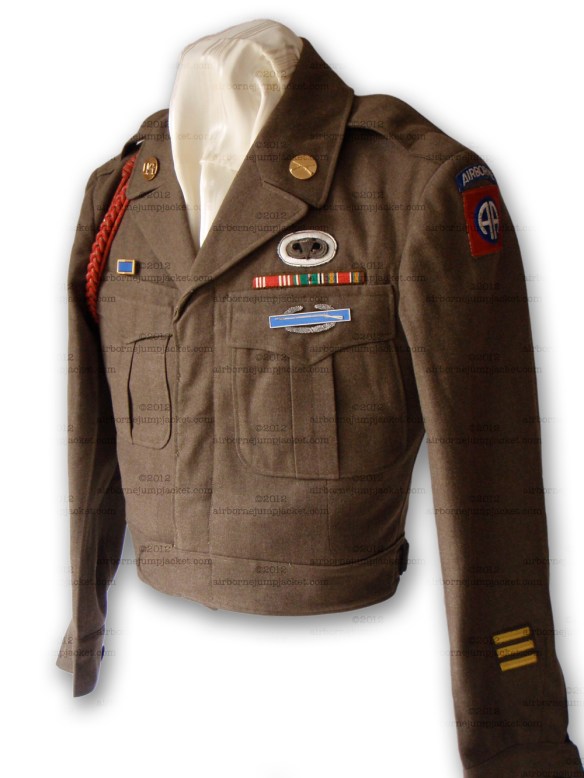
WWII 502nd PIR 508th PIR 101st Airborne Division Uniform Grouping

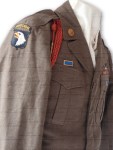
This group belonged to a paratrooper who was a member of I Company, 502nd Parachute Infantry Regiment of the 101st Airborne Division during WWII.  After the war ended, he was transferred to the 508th Parachute Infantry Regiment of the 82nd Airborne Division for occupation of Germany duty.  This was a common practice among the US Airborne units during WWII.  Airborne personal were often transferred to different regiments and divisions, starting with the end of the war in Europe, dependent on how long they had been in the service, how many points they had accumulated, and the needs of the various units.

This group includes his Ike jacket which has the insignia common to the 508th Parachute Infantry Regiment in the occupation period.  The black and white oval indicates the 508th PIR.  The ribbon bar is German made and I have seen this exact style of ribbon bar on other Ike jackets from the 508th PIR in the occupation period.  The jump wings are sterling and pin back.  On the left sleeve is an 82nd Airborne Division patch and on the right sleeve is a 101st Airborne Division patch and the Belgian Fourragere.  The 101st patch on the right sleeve indicates that this was a former unit that he had served in combat with.

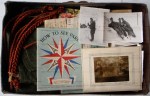
This group had a box full of stuff (pictured) from his service in World War Two.  It contained the white silk scarf and white gloves which were used by the 508th PIR for for formal functions.  There are several paper items including passes, a ration card, a Berchtesgaden tourist brochure, a folder with commerical photos of paratroops in action, and other miscellaneous paperwork.  There are a stack of photos of him and his paratrooper friends in uniform on holiday including a bunch of shots of them skiing at a ski resort.  Also included was a piece of camouflage parachute material that he had cut from a chute and his American flag armband.  The flag armband is my favorite piece because he put a roster the names of his fellow members of Third Platoon, I Company, 502nd PIR on the back along with the phrase “Ready to Jump”.  Please note that we have intentionally blurred the name of this Veteran on the two passes, ration card, and the flag armband, for privacy.

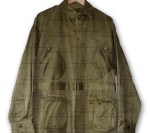
WWII 501st PIR 101st Airborne Division Paratrooper Reinforced Jump Jacket

Pictured is an original reinforced jump jacket that belonged to a paratrooper of the 501st Parachute Infantry Regiment of the 101st Airborne Division during WWII.  The Veteran was a member of the Headquarters Company of the 3rd Battalion of the 501st PIR.  This jump jacket was purchased by a good friend, and very well respected Airborne collector, directly from the Veteran many years ago.  I was lucky enough to acquire it from my friend a couple of years ago.

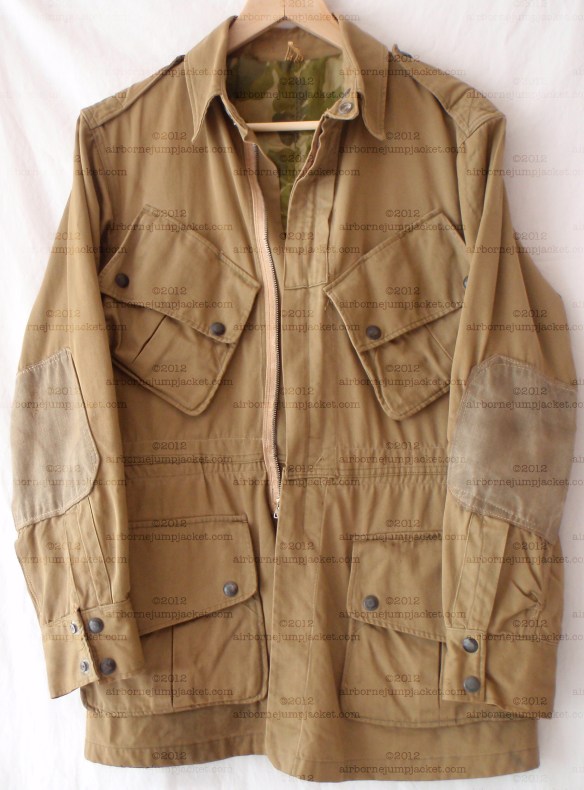
Riggers from the 101st Airborne Division added canvas reinforcements to the elbows, pockets, and knees of the M42 jump suits prior to the D-Day invasion.  This jacket still has the canvas elbow reinforcements, but the Veteran later removed the canvas reinforcements from the lower pockets.  You can still see where the reinforcements were sewn to the lower pockets.

Real reinforced M42 jump jackets and jump pants from any of the WWII units are generally rare, but only a hand full of 501st PIR reinforced items have survived to today.  Another unique feature of this jacket, is that the paratrooper had camouflage parachute material sewn into the interior in order to give it a really cool appearance.

WWII Company D 505th PIR 82nd Airborne Division Grouping

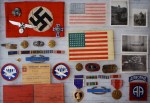
This group was purchased directly from a paratrooper of Company D of the 505th Parachute Infantry Regiment, 82nd Airborne Division. He was with Co. D, 505th PIR during their jump in Normandy during D-Day and was with them until the end of the war. He was wounded in Holland during operation Market Garden. It consists of his dog tag, jump wing sewn on to a 505th PIR oval, ribbon bars, wrist bracelet with his name, Good Conduct Medal engraved with his name, CIB, cap disc patch, 82nd Airborne patch, collar discs, purple heart, 2 American invasion armband flags, paperwork, other misc. insignia, and a number of photos (only a few of which are shown here), including one showing him standing with his Browning.

The thing that I like best is the piece of the parachute canopy fabric that he had many members of Company D, 505th PIR sign. Also pictured are some of his German souvenirs which he brought back including a German armband and a skull removed from a German visor cap.  American soldiers in WWII were known for their love of acquiring captured souvenirs from their enemies.   Insignia like these were particular favorites because they were easy to carry and mail home.  Please note that in order to maintain the Veteran’s privacy, we have intentionally blurred his name on the paperwork, bracelet, and dog tag in the photos.

WWII 82nd Airborne Division Reinforced M42 Jump Jacket

This World War Two reinforced M42 jump jacket belonged to a paratrooper of the 307th Airborne Engineer Battalion, Company C. C Company, of the 307th was attached to the 504th Parachute Infantry Regiment of the 82nd Airborne Division throughout World War Two. This jump jacket was purchased directly from the Veteran a few years ago and you can see the Veteran in photos showing him wearing and holding the jacket at the time it was purchased.

C Company of the 307 Airborne Engineers became legendary for their help in the crossing of the Waal River in Holland on September 20, 1944, during the Market Garden campaign. This crossing is most famously portrayed in the movie A Bridge Too Far, in the scene where Robert Redford leads his troops of the 3rd Battalion of the 504 PIR across the river in small canvas boats. C Company of the 307 Airborne Engineers provided two or three men per boat to paddle across the river in the first wave, and then to return the boats back to the other side of the river for additional loads of troops. The Veteran this jacket belonged to was one of the Airborne Engineers in the boats. At the time this jump jacket was purchased, he talked about how he could not believe that he had survived the crossing because the opposition from the Germans was so strong. When it was purchased, he stated orally and in a signed letter, that this is the jump jacket that he wore during his entire time in Holland.

Although the rest of the US Airborne units had switched over to the new M43 uniform for Market Garden, members of the 504th, and their attached units, still often wore their M42 jump suits in Holland.  The 504th had originally had their M42 jump suits reinforced with canvas on the pockets, elbows, and knees like the rest of the members of the 82nd Airborne Division in anticipation for the D-Day landings in Normandy.  The 504th PIR, and their attached units like C Company, 307th Airborne Engineers, were later withheld from the D-Day landings and instead held in reserve in England.  This was because they had previously been detached and left to fight in Italy long after the rest of the 82nd Airborne Division had been relieved and sent back to England.  They had seen very tough combat and suffered many casualties in Italy, so General Ridgway decided that they needed to be held back from the Normandy D Day jump in order to have more time to rest and refit.